
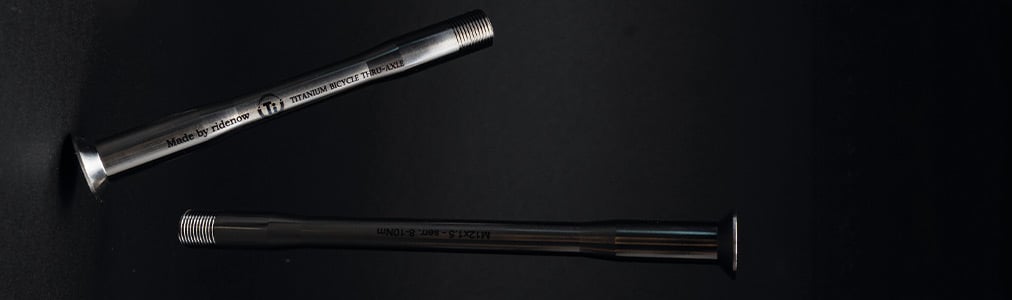
Thru Axles & Quick Releases – The Strong Boost for Your Bike
Right in the middle of the flow on the trail or during a sprint on the road, your bike suddenly doesn’t feel as direct and responsive as usual, and you notice an unsettling play in the wheel. It might just be the axle deciding whether your bike stays stable or not. Whether it’s a thru axle or a quick release – both systems keep your wheel securely in the frame, but with completely different strengths. The right choice makes your bike stiffer, safer, and faster. And that’s exactly where we at R2BIKE come in, helping you find the perfect solution for your setup.
want read more.
Why the Axle Affects Your Riding Experience
Whether you ride an MTB, road bike, gravel bike, or e-bike – the axle is the invisible link between the frame, fork, and wheel. It determines how directly your power is transferred, how stable your bike is in corners, and whether you maintain control even under full braking.
- Safety: A stiff axle prevents play in the dropout – especially important for disc brakes and large wheels (e.g., 29ers).
- Stiffness: Thru axles offer up to 30% more torsional stiffness than quick releases – ideal for demanding trails or fast descents.
- Weight & Handling: Modern thru axles are hardly heavier than quick releases but are significantly more stable. And with titanium or carbon variants, you can even save grams.
- Practicality: Both systems can be released in seconds – whether for a tire change or transport.
Thru Axle vs. Quick Release: Which One Is Right for You?
Quick Release – The Classic for Rim Brakes
- How does it work? A simple lever mechanism that clamps the axle through the open dropout – tool-free and mounted in seconds.
- For whom? Ideal for road bikes, touring bikes, or classic bikes with rim brakes. Also for retro fans who value simple handling.
-
Advantages:
- Lightweight, affordable, and proven for over 100 years.
- Perfect for quick tire changes (e.g., on a road bike).
-
Disadvantages:
- Less stiff than thru axles – play can occur under high braking loads.
- Not compatible with modern disc brake setups.
Our Tip: If you use rim brakes, titanium quick releases (e.g., from Tune or Extralite) are the ultimate upgrade – lightweight, stable, and stylish.
Thru Axle – The High-Tech Standard for Disc Brakes
- How does it work? The axle is screwed through the closed dropout (usually with a hex key or lever) – for maximum stiffness.
- For whom? MTB, gravel, e-bike, or road bike with disc brakes. Thru axles are essential here because they safely transfer the forces from the brake discs into the frame.
-
Advantages:
- Torsionally stiff: No play, even under extreme loads.
- Quickly mounted: Modern lever systems (e.g., from DT Swiss) eliminate the need for tools.
- Customizable: Available in various colors, materials (aluminum, titanium, steel), and lengths.
-
Disadvantages:
- Slightly more expensive than quick releases.
- Not compatible with older frames without thru axle mounts.
Our Tip: Pay attention to the axle standard of your frame (e.g., 12x142 mm, 15x110 mm Boost). The dimensions are usually printed on the old axle or in the frame specifications.
Buying Guide: What You Need to Consider
1. Check Compatibility
- Brake system: Rim brake = quick release / disc brake = thru axle.
- Axle standard: Typical dimensions for thru axles:
- Front: 12x100 mm (road bike), 15x110 mm (MTB Boost)
- Rear: 12x142 mm (road/gravel), 12x148 mm (MTB Boost)
- Thread & length: Usually printed on the axle (e.g., M12x1.5).
2. Material & Weight
- Steel: Robust and affordable (standard for quick releases).
- Aluminum: Lightweight and corrosion-resistant (standard for thru axles).
- Titanium/Carbon: Premium option for weight-conscious riders.
3. Extras for Added Comfort
- Theft protection: Axles with special keys
- Colors: Anodized axles for individual accents (e.g., red, blue, gold).
- Adapters: For child trailers or racks (e.g., from Thule or Ortlieb).