 Deutsch
 English

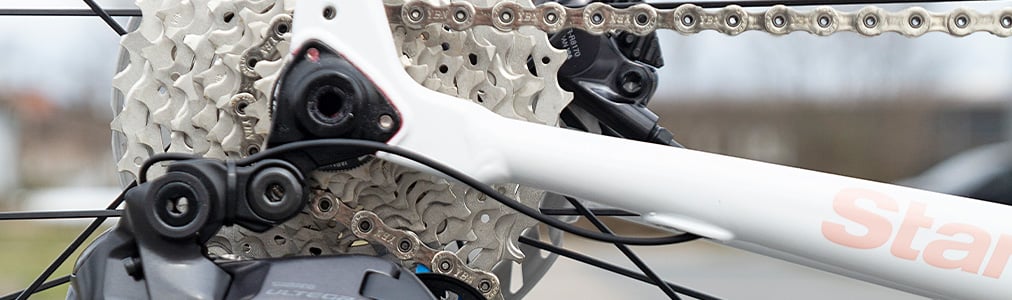
Road Bike and Gravel Cassettes – When Speed Meets Terrain
In the past, the world of road cycling was as straightforward as a German autobahn: straight, fast, and if you couldn't keep up, you were overtaken.
Today, there are more cassette variants than coffee specialties in a Berlin hipster café.
11-25 for sprinters, 11-34 for mountain goats, or maybe 10-46 for gravel adventures?
While road cyclists are still debating every gram, gravel bikers are already rolling with their monster cassettes over gravel tracks, laughing at elevation gain apps.
want read more.
Road Bike Cassettes: Precision for Speed
Classic Road Bike Cassettes
- Typical ranges: 11-25, 11-28, 11-30, 11-32 teeth
- Area of use: Road races, time trials, training on tarmac
-
Characteristics:
- Closely spaced gears for optimal cadence
- Small jumps between sprockets (often just 1-2 teeth)
- Focus on aerodynamic efficiency and weight optimization
- Perfectly tuned gear ratios for consistent speeds
Compact Road Bike Cassettes
- Typical ranges: 11-34, 11-36 teeth
- Area of use: Hilly routes, Gran Fondos, recreational road cyclists
-
Special features:
- Wider range for steep climbs
- Still closely spaced in the middle gears
- Compromise between climbing power and classic road DNA
Gravel Cassettes: Versatility for All Roads
Standard Gravel Cassettes
- Typical ranges: 11-34, 11-36, 10-36, 11-40 teeth
- Area of use: Mixed terrain, gravel tracks, light off-road sections
-
Advantages:
- Larger gear jumps for variable surfaces
- Wider gear range than classic road bike cassettes
- Adapted to changing speeds and gradients
Wide-Range Gravel Cassettes
- Typical ranges: 10-42, 10-44, 10-52 teeth
- Area of use: Bikepacking, rough terrain, MTB-like trails
-
Characteristics:
- Extreme range for all situations
- Large jumps between sprockets
- Perfect for adventures off paved routes
The Influence of 2x Drivetrains on Cassette Choices
The Interaction Between Chainring and Cassette
With 2x road drivetrains (typically 50/34T or 52/36T), the practical gear spacing changes significantly:
With a 2x drivetrain (50/34T) and 11-28 cassette:
-
Large chainring (50T): Focus on high speeds
- Smallest gear: 50/28 = 1.79 (moderate climbing gears)
- Largest gear: 50/11 = 4.55 (sprints and descents)
-
Small chainring (34T): Optimized for climbs
- Smallest gear: 34/28 = 1.21 (steep climbs)
- Largest gear: 34/11 = 3.09 (flats with tailwind)
Practical Implications:
- Overlapping gears: Many ratios are available twice
- Optimized chainline: Big chainring with small cogs, small chainring with big cogs
- Finer gradation: 20 usable gears from the 2×11 system
- Tactical shifting: Choice of chainring depending on the route profile
Cassette Choice by Crankset Setup
-
Compact Crankset (50/34T):
- 11-25 cassette: Ideal for flat to rolling terrain
- 11-28 cassette: Allround setup for most uses
- 11-32 cassette: Optimized for climbs without compromising on flats
- Standard Crankset (53/39T):
- 11-25 cassette: Classic race setup for strong riders
- 11-28 cassette: Also suitable for hilly races
- 11-32 cassette: Only advisable for very steep routes
Technical Differences: Road Bike vs. Gravel
Sprocket Design
-
Road Bike Cassettes:
- Optimized for even load distribution
- Precise shifting ramps for fast gear changes
- Lightweight through aluminum spiders in high-end models
-
Gravel Cassettes:
- More robust construction for tougher conditions
- Shifting ramps for reliable shifting under load
- Often entirely steel for maximum durability
Weight Optimization
- Road: Every gram counts – titanium sprockets and aluminum spiders
- Gravel: Durability before weight – robust materials take priority
Shifting Performance
- Road: Lightning-fast, precise shifts for racing situations
- Gravel: Reliable shifting even when dirty or under load
Freehub Compatibility
-
Shimano Road (HG)
- Compatibility: 8-11 speed road and gravel cassettes
- Standard: Widest use in road and gravel sectors
-
Shimano Road 12-speed (Micro Spline)
- Compatibility: Shimano 12-speed road cassettes
- Details: Finer splines, not compatible with HG standard
-
SRAM XDR
- Compatibility: SRAM 12-speed road and gravel cassettes
- Advantage: Allows a 10-tooth smallest sprocket for greater range
-
Campagnolo
- Compatibility: Campagnolo-specific cassettes
- Use: Primarily in high-end road bikes
Buying Guide: The Right Cassette for Your Needs
-
Road Cycling Beginners:
- Recommendation: 11-28 or 11-30 with compact crankset (50/34T)
- Reason: Universal, manageable climbs
-
Race-Level Road Cycling:
- Recommendation: 11-25 or 11-28 depending on route
- Reason: Closely spaced gears for optimum race performance
-
Allround Gravel:
- Recommendation: 11-34 or 10-36
- Reason: Good compromise between speed and off-road capability
-
Gravel Adventurers:
- Recommendation: 10-42 or 11-50
- Reason: Maximum range for unknown terrain
-
Mountainous Regions:
- Recommendation: 11-32 (road) or 10-42 (gravel)
- Reason: Sufficiently low gears for steep climbs
Conclusion: Speed Meets Versatility
While road bike cassettes are optimized for precision and speed, versatility and robustness are the focus for gravel cassettes. Choosing the right cassette depends not only on the discipline, but also on your personal riding style, preferred cadence, and local terrain.