












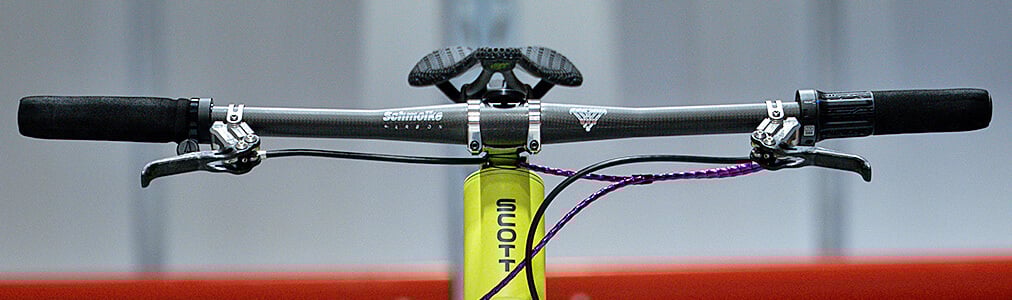
MTB Handlebars for Optimal Control on Every Trail
Looking for the perfect MTB handlebars for your mountain bike? The right handlebars are crucial for your riding feel, control, and comfort on the trail. They significantly influence your sitting position and the handling of your bike. Here you'll learn everything about the different types, materials, and characteristics of MTB handlebars.
want read more.
The Right Width for Maximum Control
The handlebar width is one of the most important factors when making your selection. Wide handlebars between 760 and 800 mm offer you maximum control and stability on technical descents. They enable more direct steering and better leverage. For narrower shoulders or tighter trails, you can opt for models between 720 and 760 mm. Many manufacturers deliberately supply their handlebars slightly wider so you can shorten them as needed.
Rise, Backsweep, and Upsweep – Important Geometry Data
The Rise describes the height of the handlebars relative to the clamp. A higher rise of 20-35 mm provides a more upright sitting position, ideal for comfort on longer tours or downhill riding. A flat rise of 0-15 mm puts you in a more sporty, aerodynamic position, perfect for cross-country and marathon riding.
The Backsweep refers to the angle at which the handlebars bend backward. Typical values range between 6 and 12 degrees. A larger backsweep relieves your wrists and improves comfort, especially on longer rides.
Not to be forgotten is the Upsweep – the angle at which the handlebar ends point upward. It typically ranges between 4 and 8 degrees and ensures an ergonomic hand position.
Materials – Aluminum, Carbon, or Titanium?
Three materials dominate the MTB handlebar market today:
Aluminum handlebars impress with their balanced ratio of strength, weight, and price. They are robust, affordable, and can withstand a crash. A high-quality aluminum handlebar weighs about 220-350 grams.
Carbon handlebars score with lower weight while maintaining high stiffness. A carbon model weighs on average around 150-200 grams and also offers better vibration damping. However, the high-tech construction is reflected in the higher price. Note that carbon handlebars show less tolerance in crashes and should be inspected afterwards.
Titanium handlebars combine the best of both worlds and are considered a premium option for demanding bikers. With a weight of approximately 180-250 grams, they are lighter than aluminum but slightly heavier than carbon. Their great advantage: they offer excellent natural vibration damping and almost unlimited durability. Titanium handlebars are extremely fatigue-resistant and much tougher than carbon – they tend to deform under excessive load rather than break. Compared to aluminum, they impress with better damping properties and higher strength at lower weight. Unlike carbon, they usually don't need to be replaced immediately after a crash. The main disadvantage is the significantly higher price, which makes these handlebars an exclusive option.
The Right Clamp for Your Bike
The most common clamp diameters are 31.8 mm and 35 mm. The larger 35 mm standard offers more stiffness but can also mean less comfort. Be sure that handlebars and stem have the same clamp diameter.
Choosing the Right Handlebars
When selecting your MTB handlebars, you should consider your personal preferences, riding style, and intended use:
- For Cross-Country, Marathon, and Down Country: narrower handlebars (720-760 mm) with low rise
- For All-Mountain and Trail: medium to wide handlebars (740-780 mm) with medium rise
- For Enduro and Downhill: wide handlebars (760-800 mm) with higher rise
Proper Installation – Crucial for Safety and Performance
The proper installation of your MTB handlebars is just as important as selecting the right model. Incorrect installation can not only affect performance but, in the worst case, lead to dangerous defects.
The correct torque is the decisive factor here. If you exceed the values specified by the manufacturer, you risk material fatigue or even breakage – particularly critical with carbon components. If the torque is too low, however, the handlebars can twist or loosen during riding. Typical torque values range between 4 and 8 Nm, with carbon handlebars often requiring lower values than aluminum or titanium.
Definitely invest in a high-quality torque wrench. This precise tool ensures that you apply exactly the right torque, neither too tight nor too loose. When purchasing, look for a measuring range of 2-20 Nm, which covers the usual values in the bicycle sector.
The use of assembly paste is also important – especially with carbon components. The special pastes increase friction between the parts and allow secure fixation at lower torque. This is particularly important when combining carbon with aluminum or titanium to avoid material damage.
During installation, you should also pay attention to even tightening. Tighten the screws alternately and in small increments until you reach the final torque. This prevents stress peaks and distortion of the material.
Your MTB handlebars are more than just a component – they are your direct connection to the bike and significantly shape your riding experience. The right choice and professional installation ensure more control, comfort, and ultimately more fun on the trail!