












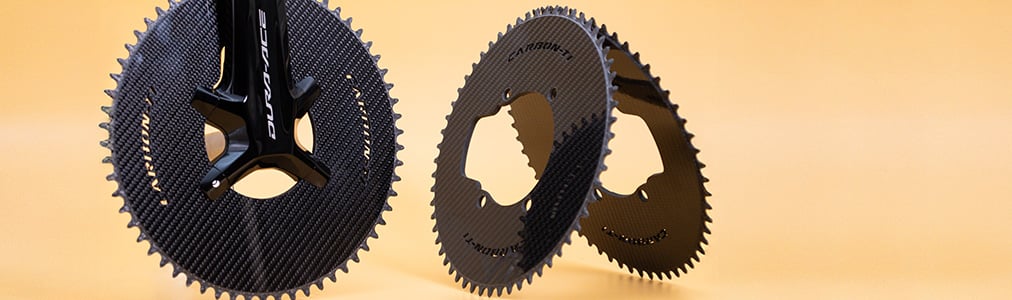
Spider Mount Chainrings – Proven Versatility for Every Drivetrain
What are Spider Mount Chainrings?
Spider mount chainrings are the classic and proven solution for bicycle drivetrains. They are mounted to the crank using a spider (crank arm with multiple mounting arms) and offer universal compatibility thanks to standardized bolt circle diameters (BCD - Bolt Circle Diameter). At R2BIKE you will find high-quality spider chainrings for all common drivetrain systems and bolt circle diameters.
want read more.
Page 1 of 6
Items 1 - 59 of 304
Spider Mount vs. Direct Mount – The Comprehensive Comparison
Spider Mount Chainrings
Advantages:- Universal compatibility due to standardized BCDs
- Easy change between different tooth counts
- Lower cost for purchase and replacement
- Wider selection of sizes and manufacturers
- Easy repair thanks to widely used standards
- Flexibility for upgrades and adjustments
- Higher weight due to the additional spider
- Lower stiffness in power transfer
- More wear parts (spider bolts)
- Possible play development over time
Direct Mount Chainrings
Advantages:- Lower weight due to elimination of the spider
- Greater stiffness and more precise power transfer
- More compact design for modern geometries
- Optimized chain guidance by direct positioning
- Manufacturer-specific standards
- Limited flexibility when changing tooth counts
- Higher replacement costs
- More complex compatibility check
Bolt Circle Diameters (BCD) for Spider Mount – The Standard Guide
Road/Gravel Bolt Circles
130mm BCD (5-Bolt)- Standard size for road compact cranks
- Tooth range: 38-53 teeth
- Use: Shimano 105, Ultegra, Dura-Ace; SRAM Rival, Force, Red
- Typical combinations: 50/34T, 52/36T, 53/39T
- Compact standard for smaller chainrings
- Tooth range: 33-50 teeth
- Use: Compact cranks, cyclocross, gravel
- Typical combinations: 46/30T, 48/32T
- Modern variant for current Shimano cranks
- Use: Shimano Ultegra R8000+, Dura-Ace R9100+
- Optimized power distribution due to 4-point mounting
MTB Bolt Circles
104mm BCD (4-Bolt)- MTB standard for mountain bikes
- Tooth range: 30-44 teeth (1x), up to 36/22T (2x)
- Use: Shimano XT, XTR; SRAM X0, XX1
- Universal compatibility between manufacturers
- Compact MTB standard for smaller chainrings
- Tooth range: 28-38 teeth
- Use: 1x drivetrains, special cranks
- Weight advantage due to smaller spider
- Inner chainring for 2x and 3x systems
- Tooth range: 20-32 teeth
- Use: Combined with larger outer chainring
Oval vs. Round Chainrings for Spider Mount
Round Chainrings
Characteristics:- Even power transfer throughout the pedal rotation
- Universal compatibility with all derailleurs
- Proven technology with long lifespan
- Easy maintenance and adjustment
- Endurance rides at a steady pace
- High cadence riding
- Beginners and casual riders
- Time trial and track cycling
Oval Chainrings
Operating Principle:- Variable gear ratio depending on pedal position
- Optimized power use in the strongest pedal phase (3-9 o'clock)
- Relief in the weakest phase (12-6 o'clock)
- Timing optimization by correct alignment
- Increased efficiency: Up to 5% better power output
- Improved traction: Smoother power transfer when climbing
- Reduced strain: Less stress for knee and lower leg
- Better oxygen intake: Optimized muscle performance
Important note: Oval chainrings require precise alignment – the largest radius must be at the 3 o'clock position (maximum power).
Drivetrain Compatibility and Chain Systems
1x vs. Multi-Chainring Systems
1x Drivetrains:- Chainring range: 28-50+ teeth depending on use
- Special features: Narrow-wide tooth profile for chain retention
- Cassette range: 10-50T or larger for gear variety
- Rear derailleur: Clutch function for chain stability
- Advantages: Simplicity, low weight, less maintenance
- Chainring combos: 46/30T (gravel), 36/26T (MTB), 50/34T (road)
- Shifting optimization: Matched tooth jumps for smooth transitions
- Chainline: Optimized for the middle range of the cassette
- Front derailleur: Accurate movement between chainrings
- Traditional solution: 44/32/22T typical for trekking
- Maximum range: Wide gear range
- More complex operation: More shifting logic required
Buying Guide: Finding the Perfect Spider Chainring
Ensure Compatibility
- Measure bolt circle diameter: Identify BCD of your crank
- Number of mounting points: 4-bolt or 5-bolt system
- Drivetrain type: 1x, 2x, or 3x system
- Check the chainline: Boost vs. non-Boost standard
Optimize Tooth Count
Consider terrain:- Flat terrain: Larger chainrings for higher speeds
- Hilly terrain: Smaller chainrings for easier pedaling
- Mixed terrain: Choose a balanced gear ratio
- Trained riders: Can use larger gear ratios
- Casual riders: Smaller chainrings for comfort
- Rehabilitation: Very small gear ratios for joint-friendly riding
Recognize Quality Features
High-quality spider chainrings offer:
- Precision CNC manufacturing for optimal roundness
- Hardened materials for long service life
- Optimized tooth profiles for smooth shifting
- Corrosion-resistant surfaces
- Brand compatibility for perfect function